Was Kennard Davis Jr.’s disappointing year at BYU just an off season, or a sign he isn’t built for high-level Power Five basketball?
By Calvin Barrett | May 6, 2026
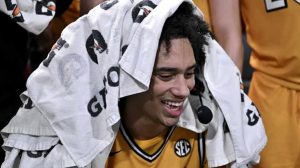
Former BYU guard Kennard Davis Jr. has officially committed to the Missouri Tigers for his senior season, marking his third team in four years. The St. Louis native now heads closer to home for one last opportunity to prove himself at the college level.
Davis chose Missouri over several major programs, including Kentucky Wildcats, Ole Miss Rebels, and Mississippi State Bulldogs. Despite an underwhelming junior campaign in the Big 12, high-major schools still saw value in the former Missouri Valley Conference standout.
After briefly entering the NBA Draft without generating much attention from scouts—especially compared to BYU stars AJ Dybantsa, Richie Saunders, and Egor Demin Wright—Davis now gets one final shot in Columbia to revive his professional prospects.
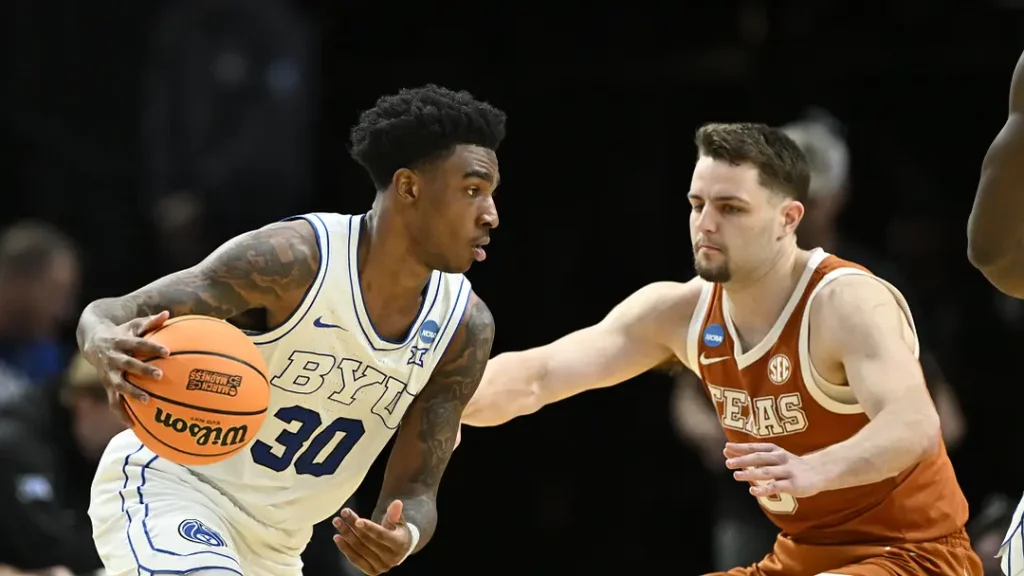
His lone season with BYU Cougars was filled with inconsistency. Brought in as a reliable 3-and-D contributor, Davis struggled for much of the season from beyond the arc, shooting under 30% from three for long stretches before a late-season surge lifted him to 32.1%.
Defensively, he remained valuable—especially after Saunders suffered an ACL injury—but offensively, Davis never became the dependable floor spacer BYU expected. The Cougars hoped he would complement their star trio by punishing defenses that collapsed on Dybantsa or Wright, but against the athleticism and physicality of the Big 12, his offensive confidence appeared to fade.
At midseason, concerns about his shooting woes had already become impossible to ignore. Poor outings against teams like Utah Utes, Kansas State Wildcats, Pacific Tigers, and Clemson Tigers highlighted how heavily BYU relied on its top scorers. Without consistent production from Davis, the Cougars’ offense became easier to contain.
BYU ultimately finished as the No. 10 seed in the Big 12 Tournament and exited early from the NCAA Tournament, reinforcing fears that the team lacked enough offensive balance.
Looking at Davis’ career arc raises an important question: was his breakout sophomore season at Southern Illinois Salukis the exception rather than the norm?
Career Statistics
- Freshman: 4.2 PPG, 3.0 RPG, 30% 3PT, 41.7% FG
- Sophomore: 16.3 PPG, 4.9 RPG, 37.6% 3PT, 45.5% FG
- Junior: 8.5 PPG, 2.7 RPG, 32.1% 3PT, 39.5% FG
His sophomore year remains his peak across nearly every major statistical category, including assists, steals, and free-throw percentage. That season, Davis thrived in a ball-dominant role where he could create offense and control possessions. At BYU, surrounded by higher-level talent and asked to fit into a more complementary role, he never looked fully comfortable.
How much of his regression stemmed from Kevin Young’s offensive system versus Davis’ own limitations remains debatable. Still, the fit clearly never materialized the way either side envisioned, making a transfer feel inevitable.
Whether Missouri can put him in a better position to succeed remains uncertain. If he can regain the confidence and freedom he had at Southern Illinois, a bounce-back season is possible. But after such a noticeable decline—even compared to his freshman year—it’s fair to wonder if his best basketball may already be behind him.